
Doberman Pinscher
"An elegant guardian with a razor-sharp mind and a heart of gold."
Overview
The Doberman Pinscher makes a remarkably devoted family companion, far removed from outdated cinematic stereotypes. Often called "Velcro dogs," this large dog breed craves constant human connection and thrives when fully integrated into indoor family life rather than being left in a yard.
Raising this alert guardian requires a significant time investment. While their sleek coat means minimal shedding, they possess boundless energy. A home with a secure garden is vastly preferable to apartment living, as they need vigorous daily exercise and continuous mental stimulation to stay balanced and happy.
When it comes to family dynamics, they are fantastic with school-aged children and teenagers. However, for families with toddlers, their physical size demands strict supervision. Because they show affection by leaning heavily against legs, they can easily knock over smaller kids, and erratic running can sometimes trigger their prey drive.
Early socialization and consistent, firm training are non-negotiable to manage their natural guarding instincts in a healthy way. Potential owners must also consider the budget, as quality food and care bring the monthly cost around 225 euros. For a family ready to provide clear rules, this highly intelligent breed offers an unbreakable, loving bond.
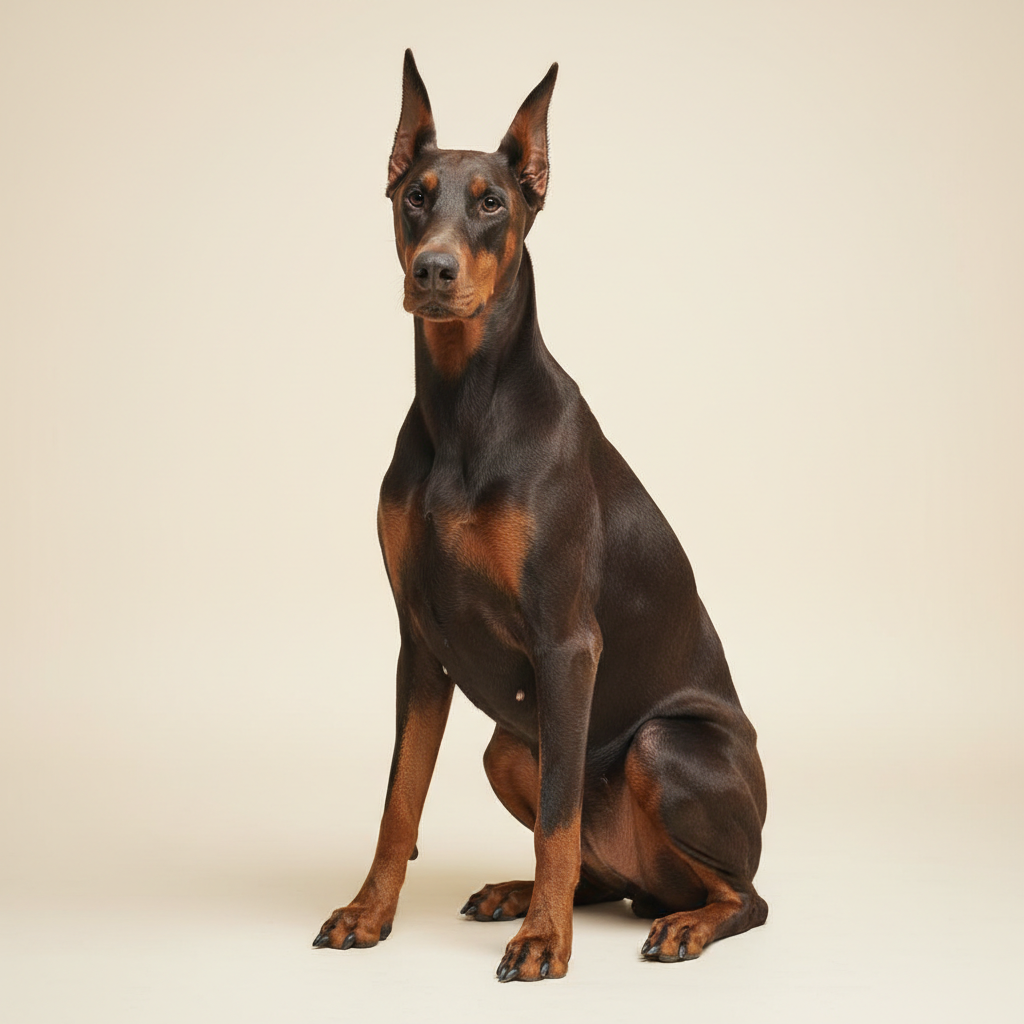
Key facts
- Size
- Large
- Weight
- 27–45 kg
- Life expectancy
- 10–12 years
- Daily exercise
- 90 min/day
- Estimated total
- 225€/month
- Country
- Germany
Character & temperament
The Doberman's personality is a blend of intense alertness and deep affection. They are incredibly smart dogs, often ranked among the top five most intelligent breeds, which means they learn quickly but also require constant mental engagement. At home, they are remarkably sensitive to the moods of their owners; if you are stressed, they will likely feel it too. They don't just want to be in the same room as you; they want to be touching you, often leaning against your legs or resting their head on your lap.
When it comes to strangers, a well-socialized Doberman is naturally reserved and watchful. They aren't aggressive without cause, but they will position themselves between their family and a newcomer until they are sure there is no threat. This 'guardian instinct' is innate and shouldn't be trained out, but rather managed through exposure to different people and environments. They are discerning judges of character and will look to their owner for cues on how to react to guests.
With their primary owner, the Doberman forms an unbreakable bond. They are often described as 'one-person dogs,' but in reality, they are loyal to the whole family while usually choosing one favorite human to follow everywhere. They are eager to please and highly motivated by both praise and food. However, they can be pushy if they feel there is no clear leader in the house. This is a breed that needs to know the rules, which gives them the security they need to relax and be the affectionate companion they truly are.
Living with children
Dobermans can be wonderful with children, especially those within their own family. For school-aged children (6-12) and teenagers, they are active, fun-loving playmates who will enjoy running in the yard or learning tricks. They are generally tolerant of the noise and energy of older kids. However, because they are so physically powerful and affectionate, they often 'lean' on people to show love, which can easily knock over a younger child. Their intensity can also be a bit much for very sensitive or fearful children.
When it comes to toddlers (3-6), supervision is non-negotiable. While the Doberman is usually patient, they are large dogs with a high prey drive that can be triggered by erratic running or screaming. It's vital to teach children how to respect the dog's space and never to bother them while sleeping or eating. For families with babies, the transition requires careful planning. A Doberman's protective nature can sometimes cause them to be overly anxious around a new crying infant. If introduced properly and boundaries are set, they become the baby's most dedicated guardian.
With other pets
Dobermans can live harmoniously with other pets if socialized early. Within their own house, they often become best friends with other dogs. However, male-to-male aggression is a known trait in the breed, so keeping two males together requires careful management and experience. With cats, they generally do well if raised with them from puppyhood, though their prey drive might tempt them to chase if the cat runs. They should always be supervised around smaller animals like rabbits or hamsters, as their hunting instincts remain strong. Outdoor encounters with strange dogs should be handled with care.
Health & prevention
The elephant in the room for Doberman health is Dilated Cardiomyopathy (DCM), a genetic condition where the heart enlarges and fails. Nearly 50% of the breed may be affected, making annual echocardiograms and Holter monitoring essential for early detection. They also face risks from Von Willebrand’s Disease (a blood clotting disorder) and Hypothyroidism. Gastric Torsion (bloat) is a critical emergency risk due to their deep chests; owners must learn to recognize symptoms like unproductive retching.
To ensure a healthy life, never skip yearly vet visits. Beyond standard vaccinations, focus on weight management, as extra pounds put undue stress on their heart and joints. A responsible breeder will provide DNA clearances for VWD and recent cardiac screenings for both parents. While their lifespan is 10-12 years, proactive care and early intervention for heart issues are the only ways to reach the double digits. Expect to spend more on preventative diagnostics than on actual treatments in the early years.
Health risks
- •Dilated cardiomyopathy
- •Von Willebrand disease
- •Hypothyroidism
Care
Nutrition
A Doberman needs a high-quality diet specifically formulated for large, active breeds. Due to their risk of Gastric Torsion (bloat), it is crucial to feed them two or three smaller meals per day rather than one large one, and avoid exercise for an hour before and after eating. A typical 35kg adult requires about 350-450 grams of premium kibble daily, depending on activity level. Including Omega-3 fatty acids is beneficial for their skin and coat health. Always monitor their weight closely; you should be able to feel their ribs easily but not see them prominently.
Grooming & hygiene
Grooming is the easiest part of owning a Doberman. Their short, sleek coat requires only a weekly brushing with a rubber mitt or soft bristle brush to remove dead hair and skin. They don't have a typical 'doggy' smell, so baths are only necessary every couple of months or when they get particularly dirty. You must pay close attention to their nails; they grow fast and can cause discomfort if not trimmed regularly. Ear cleaning and dental care should be part of the routine, but overall, professional grooming is rarely needed.
Exercise & training
Exercise plan
A Doberman requires a minimum of 90 minutes of structured activity daily. A typical week includes: Monday-Friday: 45-minute brisk morning walk, 20-minute training session (obedience/tricks), and 30-minute off-leash run or fetch in a secure area. Saturday: A 2-hour hiking trail or long-distance jog to build endurance. Sunday: Mental enrichment day involving scent work, puzzle toys, and a relaxed social walk in a new environment. Regular physical exercise is not enough; they need a 'job' to do. Without this structured routine, they may develop neurotic behaviors or become destructive at home due to unspent energy.
Training
Training a Doberman is a rewarding but intensive journey. Their high intelligence means they can master commands in just a few repetitions, but they can also get bored easily. Use positive reinforcement and keep sessions short, fast-paced, and varied. They respond best to a 'firm but fair' approach; harsh corrections can break their sensitive spirit or lead to defiance. Socialization must start from the day they arrive home—expose them to different sights, sounds, and people to prevent over-protectiveness. Training should be lifelong, not just for puppyhood. Expect to spend at least 15-20 minutes a day on active obedience to keep their mind sharp and balanced.
Monthly cost
Monthly budget based on a high-quality large-breed diet, comprehensive health insurance (highly recommended for DCM), and basic hygiene. Vet costs are averaged but can spike due to breed-specific heart screenings.
Estimate for Spain, healthy adult dog. Varies by region and provider.
Pros & cons
Pros
- ✓Extremely intelligent and easy to train for various tasks.
- ✓Highly loyal and natural guardians of the home and family.
- ✓Low grooming requirements and minimal 'dog odor'.
- ✓Athletic and versatile, making them great for sports and outdoor life.
- ✓Affectionate and deeply bonded to their human 'pack'.
Cons
- !Prone to severe separation anxiety if left alone for long periods.
- !Genetic health issues like DCM can lead to high unexpected vet bills.
- !Very sensitive to cold weather; requires coats and indoor living.
- !Can be overly protective or suspicious if socialization is ignored.
- !High intensity and physical strength can be overwhelming for some owners.
Ideal for
- • Active individuals who enjoy daily running or hiking routines.
- • Families with school-aged children looking for a loyal guardian.
- • Owners who work from home and want a constant companion.
- • Experienced trainers who enjoy working with high-intelligence breeds.
Not recommended for
- • First-time dog owners without professional training support.
- • People who live in extremely cold regions without indoor space.
- • Families who are away from home for more than 4-5 hours daily.
How it fits each scenario
Possible only if you spend 3 hours outside daily; they are surprisingly calm indoors but need space to stretch.
Ideal, provided the garden is securely fenced; they still need to sleep inside with the family.
They handle heat better than cold, but avoid peak sun hours as their dark coats absorb heat quickly.
They struggle significantly in the cold; a winter wardrobe and indoor heating are non-negotiable requirements.
Not ideal; their size and 'lean-in' affection can easily knock over a small child, causing accidental injury.
Excellent companions for older children who respect boundaries and enjoy active, physical play.
Not recommended; their high intelligence and physical power can quickly overwhelm a novice owner.
Ideal match; an experienced handler will appreciate their intelligence and drive without being intimidated.
They are the ultimate partners for runners and hikers, thriving when they are part of every adventure.
A poor choice; they are 'Velcro dogs' that will suffer mentally if ignored for 8-10 hours a day.
Not suitable for allergy sufferers; they shed short, needle-like hairs that stick to everything.
Risky; the potential for expensive heart conditions means you must have a solid emergency fund.
Origin & history
The Doberman Pinscher originated in Germany around 1890, created by Karl Friedrich Louis Dobermann. As a tax collector and night watchman, he sought to breed a dog that was courageous, intelligent, and highly protective for his dangerous routes. He utilized various breeds to achieve this, likely including the Rottweiler, German Pinscher, Weimaraner, and Greyhound. The breed quickly gained a reputation for its utility, serving with distinction in both World Wars as scouts, sentries, and messengers. Over time, breeders focused on refining their temperament, moving away from pure aggression toward the reliable, stable, and affectionate family guardian we know today. Their history is one of service, moving from the tax man's side to the military, police work, and finally, the family sofa.
The breed was created by Karl Friedrich Louis Dobermann, a German tax collector who needed a brave and loyal protector to accompany him on his dangerous rounds.
Frequently asked questions
Are Dobermans naturally aggressive or dangerous?▾
While popular myth suggests they are 'vicious,' a well-bred Doberman is stable and loving. However, they are natural guardians and will protect their family if they perceive a real threat. Aggression is usually a result of poor breeding or lack of socialization.
Is it expensive and difficult to keep a Doberman?▾
Dobermans are 'Velcro dogs'—they need to be near you. Expect to pay €180-€250 monthly for quality food and insurance. They also require significant time for exercise and mental stimulation, which is a 'cost' in terms of lifestyle changes.
Are they good dogs for families with small children?▾
They are generally patient with kids in their 'pack.' However, due to their strength and intensity, they are better suited for children over 6-7 years old. Toddlers can find their energy overwhelming, and accidental bumps are common.
Is the Doberman a good choice for someone with allergies?▾
No, Dobermans are not hypoallergenic. They have a single coat and shed year-round. Their short hairs are like little needles that can embed themselves in carpets and upholstery, potentially triggering allergies.
How long do they live and what is their main health issue?▾
Expect roughly 10 to 12 years. Tragically, the breed is plagued by Dilated Cardiomyopathy (DCM), which can shorten their lives. Buying from a breeder who performs annual heart screenings on their breeding stock is vital.
Do Dobermans bark a lot?▾
They are moderate barkers. They don't bark for no reason, but they will give a deep, intimidating alert bark if someone approaches the door or if they sense something unusual in their environment.
Is a Doberman a good first dog?▾
Generally, no. They are highly intelligent but also very powerful and sensitive. A first-time owner might struggle to provide the firm, consistent leadership and high exercise levels they require to stay balanced.
Can they live with other dogs or cats?▾
They can coexist perfectly with other pets if raised with them. However, males can sometimes show dominance issues with other large male dogs. They usually have a high prey drive, so careful introduction to cats is necessary.
Similar family-friendly breeds

Boxer
8.9Athletic and patient with children. Known as a nanny dog. Needs intense exercise and early socialization.

Rottweiler
6.4Strong, loyal and territorial. Restricted breed in Spain: requires licence, insurance and expert handling.

Weimaraner
6.3Tireless blue-eyed hunter. Only for very active families with time to spare.